7 Trading Confluences That Turn a Raw Setup Into a High-Probability Entry
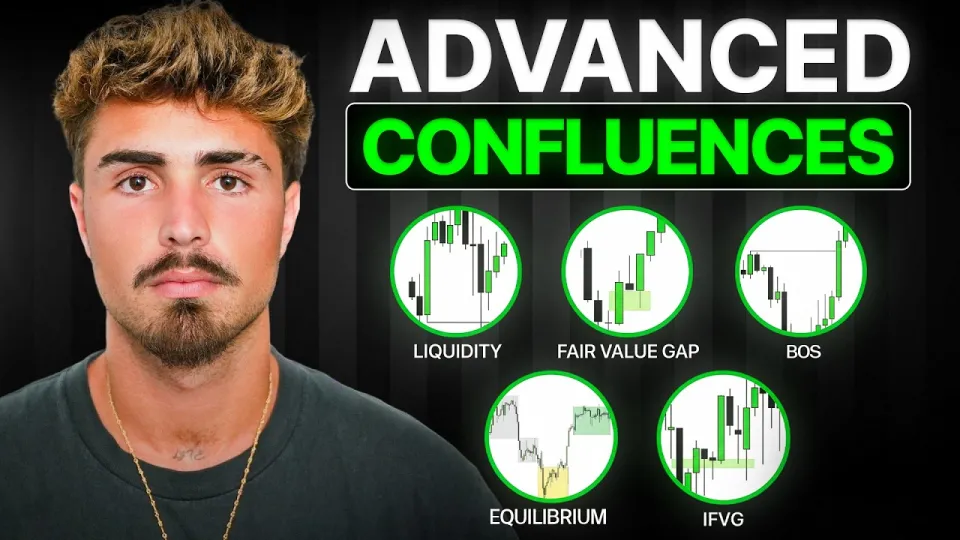
Video: Learn Every Trading Confluence In 18 Minutes
Want articles like this for your own video to promote it on YouTube and Google? Order them through the Telegram bot @sat_sit_bot. The bot writes and publishes the articles itself (with your YouTube video embedded) on popular topical websites (no ads). Try it free: 50 articles on us.
· based on the channel TJR
Key takeaways
- A confluence is a second, independent reason to take a trade — not a second indicator that repeats the first one.
- Liquidity pools sit above equal highs and below equal lows, where stop orders cluster and price often gets pulled.
- A fair value gap is a three-candle imbalance; an inverse FVG is the same zone after price breaks through it and it flips role.
- Break of structure confirms direction only when it happens with displacement, not on a slow drift through a swing point.
- Stacking three or more unrelated confluences filters out most low-quality setups, but each added condition also removes trades.
Trading with confluences means requiring several independent reasons — liquidity, imbalance, structure, session timing — to align before you risk money on a single setup. The point is not to collect indicators that all say the same thing, but to stack evidence from different sources so that one weak signal cannot drag you into a trade. TJR's breakdown of every major confluence in 18 minutes is a useful checklist, and the same framework is laid out step by step in the free trading blueprint the channel points viewers to.
Below are the seven confluences worth knowing, how each one is read on a chart, and how to combine them without turning your screen into noise.
What a confluence actually is in trading
A confluence is a second, unrelated reason for the same trade idea, and its value comes from independence rather than quantity. Two moving averages crossing in the same direction are one piece of information repeated twice; a liquidity sweep plus a fair value gap plus a session high is three separate pieces of information pointing the same way. That distinction matters because stacking correlated signals feels like confirmation while adding almost no edge.
The practical test is simple: if you deleted one of your confluences from the chart, would your reason for the trade still stand? If yes, it is a real confluence. If the trade collapses without it, you have one signal dressed up as several.
The seven confluences worth stacking
These seven cover the ground most intraday and swing traders need, and each can be checked in seconds once you know what you are looking for.
- Liquidity. Price is drawn to clusters of stop orders, which sit above equal highs and below equal lows, and around obvious swing points. A sweep of that liquidity followed by a fast rejection is one of the strongest single signals on a chart.
- Fair value gap. A three-candle imbalance where the wicks of the first and third candle do not overlap leaves an untraded zone. Price frequently returns to rebalance it before continuing.
- Inverse fair value gap. When price breaks through an FVG with conviction, the same zone can flip role — former support becomes resistance, or the reverse — and the retest becomes the entry.
- Equal highs and equal lows. Two or more highs at nearly the same price mark an obvious target and a resting pool of orders. They are less a signal on their own and more a map of where price is likely to go next.
- Break of structure. A clean break of the most recent swing high or low tells you which side is in control. Without displacement behind it, a break is often just a liquidity grab.
- Order block or origin of the move. The last opposing candle before an impulsive leg often marks where the larger participant entered, and it gives you a defined area to trade from rather than a vague direction.
- Session and timing. The same setup behaves differently in the first hour of the New York session than in the dead hours of the Asian range. Time of day is a confluence in its own right and one of the most underrated.
How to combine confluences without over-filtering
Combining confluences works best as a hierarchy rather than a checklist of equal weight, because a trader who demands five conditions on every entry will take almost no trades. Start with the directional bias from structure, then require one location confluence — liquidity, an FVG or an order block — and finally a trigger such as a rejection or a lower-timeframe break. Three layers is usually enough.
A workable rule is to cap your checklist at three or four items and to write them down before the session starts, not after a trade goes wrong. Traders who add a new condition after every loss end up with a system that fits the past and cannot be traded in the present. If you want a structured version of this, the channel's indicator set maps the levels automatically so you can spend your attention on the decision rather than the drawing.
It also helps to rank your confluences by how much they actually change the outcome. For most traders, location and timing do far more work than any single candlestick pattern, and a mediocre trigger at a great level beats a perfect trigger in the middle of nowhere.
Reading liquidity, fair value gaps and inverse FVGs together
Liquidity, fair value gaps and inverse gaps describe three different stages of the same move: where price is going, where it left inefficiency behind, and what happens when that inefficiency is broken. Price sweeps a liquidity pool, moves with displacement, leaves an FVG behind, and later returns to that zone. If the return respects the zone, it is a continuation; if price slices through it, the zone becomes an inverse FVG and the retest from the other side is the new opportunity.
In practice this means you rarely need to predict anything. You mark the pool, wait for the sweep, note where the imbalance formed, and let the reaction at that zone tell you which scenario is live. The same logic applies on any timeframe, which is why the concept scales from one-minute charts to daily ones.
Common questions traders raise about confluences
Most of the pushback on confluence-based trading comes down to three concerns: which signals actually add value, how long it takes to internalise them, and whether the market is too manipulated for any of it to matter. The honest answer to the first is that only the signals you have tested on your own data count. The answer to the second is that repetition, not more videos, is what moves a concept from theory to reflex.
On the manipulation question, the presence of stop hunts and engineered liquidity sweeps is exactly why liquidity-based confluences exist — the framework assumes the market hunts obvious orders and tries to position around that behaviour rather than fight it. What no framework can do is remove the cost of learning, which usually means a stretch of losing trades while you build screen time and discipline.
One more practical point: note-taking helps, but a checklist only becomes useful when it is short enough to run in real time under pressure. If your written plan takes ten minutes to evaluate, it is a study document, not a trading plan.
Useful links
- Full trading blueprint — the channel's structured system for becoming a consistently profitable trader.
- Indicators used daily — the toolkit that plots the levels discussed above.
- Funded account raffle — entry form for the channel's giveaway.
- Alpha Futures — funded accounts with a discount for viewers.
- Lucid Trading — funded account provider referenced in the video.
Final takeaway
Confluence trading is a filtering exercise, not a prediction exercise: structure sets the direction, liquidity and imbalance set the location, and a trigger times the entry. Keep the list short, make each item independent, and test it before you size up. TJR's 18-minute walkthrough is a solid map of the concepts, but the edge only appears once you have replayed them on your own charts. If you want the full framework in one place, start with the trading blueprint.
Questions & answers
How many confluences should a single trade have?
Most traders do well with three or four independent conditions: a directional bias, a location such as liquidity or a fair value gap, and a trigger. Adding more filters reduces trade frequency sharply and often removes good setups along with bad ones. The key is that each condition must be independent of the others.
What is the difference between a fair value gap and an inverse fair value gap?
A fair value gap is a three-candle imbalance where the first and third candles' wicks do not overlap, leaving an untraded zone. An inverse fair value gap is that same zone after price has broken through it decisively — the zone then flips role, so former support can act as resistance on the retest.
Do confluences work on any timeframe?
Yes, the logic is timeframe-agnostic because liquidity, imbalance and structure appear on every chart. What changes is the noise level: lower timeframes produce more signals and more false ones, so many traders use a higher timeframe for bias and a lower one only for the entry trigger.
Is the market too manipulated for technical confluences to work?
Stop hunts and engineered liquidity sweeps are real, but liquidity-based confluences are built around that behaviour rather than denying it. The framework assumes price seeks obvious orders and tries to position with that flow. No method removes risk, and a large share of day traders lose money.
Source: Learn Every Trading Confluence In 18 Minutes · Markdown version